

Guide 2026 sur la directive UE sur la transparence des salaires | Téléchargez l'eGuide

🇲🇹 Malta

Malta: EU Pay Transparency Directive legislation at a glance

To transpose the EU Pay Transparency Directive fully and on time, Malta established its Equal Pay (Transparency and Reporting) Regulations 2026 via Legal Notice 173 of 2026. While mostly reflecting the EUPTD baseline requirements, Malta is distinguished by more stringent internal documentation thresholds, a very short required response time for right to information requests, and clear fines for noncompliance.

Map of Malta.

Transposition

At a glance

A Bell Icon

Effective date

June 5th, 2026 for most elements; first pay gap reports are due June 7th, 2027 (first annual reports for employers with 250+ employees and triennial reports for those 150–249 employees) and June 7th, 2031 (triennial reports for those with 100–149 employees.)

A people group icon

Size of companies impacted

Reporting requirements track the EUPTD requirements (100+ employees); however, companies with 50+ employees must have formalized, written pay structures and progression criteria that are accessible to employees, and those with 25+ employees must have formalized, written pay structures in place.

A paper scroll icon

Pay transparency provisions for job applicants

Employers must provide applicants with information about pay or the pay range; this information must be provided before the recruitment process concludes in order to make sure negotiations are transparent.

A slider icon

Defining categories of workers and work of equal value

Defined based on the skills, effort, responsibilities, and working conditions necessary for the role.

Pay Equity icon graphic

Right to information

Employees have the right to receive, in writing, information about their pay and the pay, broken down by gender, of other employees who do the same work or work of equal value. The required response time for employers is 8 days.

Transparency in small groups

If providing peer-average data would jeopardize the confidentiality of one employee in a group, then this information must not be provided through direct delivery. Data must be routed through employee representatives, the State Labour Inspectorate, or the Office of the Equal Opportunities Ombudsperson.

Remediation & joint pay assessments

Employers must remediate any pay gaps of 5% or more within 6 months, otherwise they will need to conduct a joint pay assessment. The timeline for remediation must be determined in consultation with the employees’ representative.

Legal Interpretation

How legislation in Malta interprets the EU Directive’s requirements

By and large, Malta’s new Equal Pay (Transparency and Reporting) Regulations track the EU Pay Transparency Directive. However, Malta is distinguished by its low employer size threshold for pay structure documentation and by some strict response times and penalty structures. Specifically:

  • Employers must respond to employees’ right to information requests within only 8 days; this is the shortest required turnaround among all EU member states. Employers who delay beyond 45 days may face enforcement actions.
  • All organizations with 25 or more employees must document their pay criteria in writing. Those with 50 or more must make those criteria, as well as criteria for advancement, readily available to employees.
  • Employers must keep employee pay disclosures and right to information requests and documentation on file for at least 5 years.
  • The law specifies a fine structure: €2,500 to €5,000 for general compliance violations and €5,000 to €7,000 for violations of the equal pay for work of equal value principle.

Get ready to respond quickly to employee requests in Malta

With regulations in effect immediately and tight turnarounds required for right to information requests, organization and system efficiency are crucial for employers in Malta. beqom's industry-leading pay equity and transparency solution, can give you the insights you need to close pay gaps, visualize and analyze pay structures, drill down to investigate compensation at the category and individual levels, and make data-driven decisions. To see how your organization can benefit, request a personalized demo.

If you want to learn more, our EU Pay Transparency Directive eGuide gives a user-friendly breakdown of all the requirements. Our EU Directive Checklist offers a 43-step plan that makes sure that nothing falls through the cracks.

Activity by member state

EU Pay Transparency Directive Transposition Tracker

EU member states are working to transpose the EU Pay Transparency Directive into national law. We’ve created this page to keep track of each member state’s progress.

Visit the EUPTD Tracker
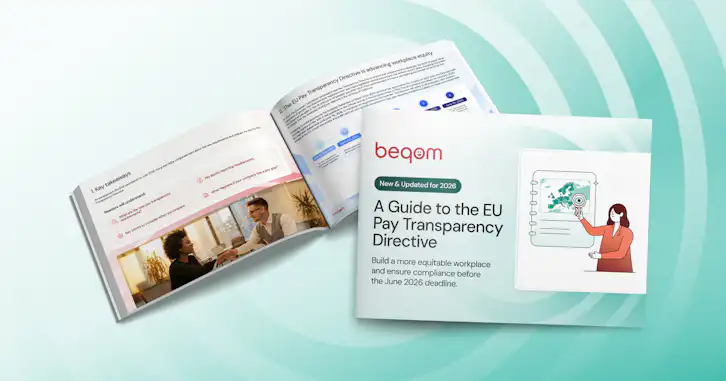
booklet image of the EU Pay Transparency Directive 2026 eGuide

Download our EU Pay Transparency Directive 2026 eGuide

Starting June 2026, organizations across the EU must comply with sweeping new pay transparency and equity regulations. Our new and updated eGuide gives you the clarity, strategies, and tools you need to act now—before it’s too late.

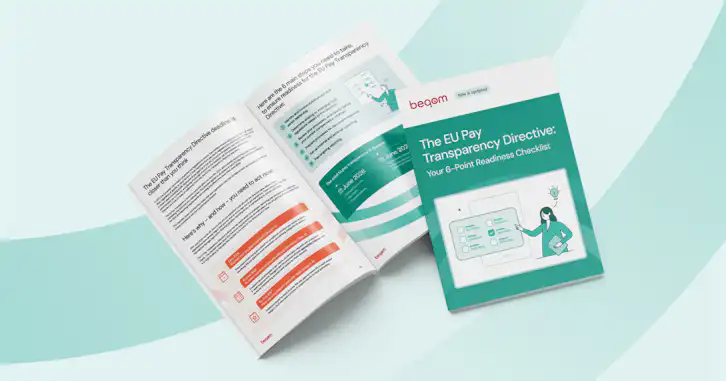
The EUPTD readiness checklist

EU Pay Transparency Directive Compliance Checklist

The June 2026 transposition deadline has now passed. We’ve put together a 43-step Compliance Checklist to help you ensure every aspect of the legislation is covered. Now’s the time to secure your organization against important fines, costly litigation, and reputational damage.

Dive into other Pay Transparency resources

Each guide, article or webinar is designed to help you navigate common pain points and complex compliance challenges with confidence. Learn from beqom’s thought leaders who distill complex topics into accessible, actionable recommendations. We provide proven frameworks and real-world examples, keeping you up to date with the latest legislation and helping you stay compliant while driving employee engagement.

Photo de Jane Anderson et Cristina Flores.
Gestion des Rémunérations Transformation RH

Du tableur à la stratégie : digitaliser la rémunération avec beqom et T. Rowe Price

Lorsque vous dépassez le stade des tableurs, le principal obstacle n'est pas la technologie, c'est la transition. Rejoignez les experts en rémunération de beqom et de T. Rowe Price afin de découvrir concrètement comment passer d'un suivi manuel chaotique à une solution de rémunération unifiée et stratégique. Découvrez les modèles précis d'optimisation, de tests d'acceptation par les utilisateurs et de gestion du changement qui transforment les utilisateurs clés en ambassadeurs de la plateforme.

Photo de Julian Alzueta et Sébastien Baehni
Gestion des Rémunérations

IA intentionnelle et rémunération : utiliser une IA explicable | échange de 30 min

Chaque décision en matière de rémunération a un impact direct sur le quotidien des collaborateurs : privilégier la rapidité ne suffit pas, la responsabilisation est essentielle. Découvrez dans cette vidéo l'intervention du directeur de l'IA de beqom, le Dr Julian Perez Alzueta, et du CTO, le Dr Sébastien Baehni, afin de découvrir comment dépasser l'IA générique au profit d'un système d'intelligence garantissant le contrôle humain sur les décisions clés.

Images de Lara Winzen de beqom et Kerstin Willer de Erste Group.
Pay transparency Équité Salariale

Démarrer ou stagner : transparence salariale en évolution, avec beqom et Erste Group

Bien que l'échéance de juin 2026 pour la directive européenne sur la transparence des rémunérations approche à grands pas, plusieurs États membres ont confirmé des retards dans sa transposition. Visionnez cette session d'experts avec beqom et Erste Group afin de découvrir pourquoi attendre n'est pas une option et comment préparer proactivement la stratégie de conformité de votre organisation dès aujourd'hui.

Portraits de Vismay Gada et Ankur Sharma
Gestion des Rémunérations

Webinaire : L'état de la rémunération et de la culture en 2026

Découvrez comment le paysage de la rémunération est passé de cycles administratifs à un levier essentiel de la culture d'entreprise et de la stratégie de la direction générale. Lors de cette session, Vismay Gada (beqom) et Ankur Sharma (Montefiore) explorent les principales conclusions du 2026 State of Comp and Culture Report.