

Guide 2026 sur la directive UE sur la transparence des salaires | Téléchargez l'eGuide

🇸🇰 Slovakia

Slovakia: EU Pay Transparency Directive legislation at a glance

Slovakia has fully transposed the EU Pay Transparency Directive through its Equal Pay Act (Act No. 76/2026 Coll. on Equal Pay for Men and Women for Equal Work or Work of Equal Value). While the new requirements mostly follow the norm for member states, some of its deadlines are quite tight, though it has also tailored some provisions to ease the burden for smaller businesses.

Map of Slovakia.

Transposition

At a glance

A Bell Icon

Effective date

June 7th, 2026 for most elements; pay structures must be established and documented by July 31st, 2026; first pay gap reports are due June 7th, 2027 (first annual reports for employers with 250+ employees and triennial reports for those 150–249 employees) and June 7th, 2031 (triennial reports for those with 100–149 employees). All subsequent reports are due on April 15th of the respective year.

A people group icon

Size of companies impacted

Reporting requirements track the EUPTD requirements (100+ employees.)

A paper scroll icon

Pay transparency provisions for job applicants

Employers must provide applicants with information about pay or the pay range; this information must be provided prior to the interview or prior to the contract.

A slider icon

Defining categories of workers and work of equal value

Defined based on gender-neutral job evaluation criteria including working conditions, physical demands, complexity, and responsibility.

Pay Equity icon graphic

Right to information

Employees have the right to receive, in writing, information about their pay level and the criteria used to determine it, and they should be informed of this right once per year. The required employer response time is 2 months for the initial request and 30 days for subsequent follow-up requests. Employee representatives and the Slovak National Centre for Human Rights may also make such requests.

Transparency in small groups

Employers are prohibited from making a broad internal disclosure if the peer-average pay data might allow an employee to deduce a colleague’s pay. In such cases, data must be routed through employee representatives or the Labour Inspectorate.

Remediation & joint pay assessments

If the report shows an unjustified gap of 5% or more in any worker category, the employer must remediate the gap within 6 months, otherwise they will need to work with employee representatives to conduct a joint pay assessment.

Legal Interpretation

How the Slovak legislation interprets the EU Directive’s requirements

Many of the requirements implemented in Slovakia are aligned with the EUPTD baseline. However, legislators made a number of adjustments, as follows:

  • All covered employers must establish and document pay structures based on gender-neutral, objective criteria by July 31st, 2026. If employee representatives exist, these criteria must be formally negotiated and agreed upon.
  • Employers with fewer than 50 employees are not required to document and share pay progression criteria. This is an exemption allowed under the EUPTD.
  • Slovakia opted to strengthen equal pay for work for equal value protections by extending them to employees of the same sex. In other words, these principles must apply to employees across the board.
  • The right to information provision applies immediately; however, the requirement for employers to provide the average within-category pay levels is deferred until 2028 (for 2027 data). Until then, employers should provide employees’ individual pay criteria.
  • Although covered employers’ first pay gap reports are due on June 7th of the relevant year (either 2027 or 2031), subsequent reports will be due on April 15th, meaning that employers will have a tighter window for preparing their second reports.
  • Due to strict privacy safeguards in Slovak law, employers cannot provide average pay data by posting it on an employee intranet. (This option is available in some other member states.) Employers are encouraged to use an intranet to publish pay structure information and evaluation criteria; however, the individual pay comparisons and category averages covered under the right to information provision must be handled on an ad-hoc basis by request only. Our two-part series on designing and implementing your pay information request process may help prepare your organization to respond to employees’ inquiries.

To support employers in complying with the new requirements, Slovakia’s government has published a methodology document.

Preparing for EUPTD compliance in Slovakia

Slovakia has extended equal pay protections beyond male-female categories, and employers are already required to have compliant pay structures in place. Built on industry-leading research, beqom's Pay Equity and Transparency tool is a user-friendly platform that delivers detailed insight into your organization’s pay structure so you can make sure it is equitable for all employees, Directive-compliant, and sustainable.

If you want to learn more, our EU Pay Transparency Directive eGuide gives a user-friendly breakdown of all the requirements. Our EU Directive Compliance Checklist offers a 43-step plan that makes sure that nothing falls through the cracks.

To see all the capabilities of our pay equity and transparency tool, book a demo today.

Activity by member state

EU Pay Transparency Directive Transposition Tracker

EU member states are working to transpose the EU Pay Transparency Directive into national law. We’ve created this page to keep track of each member state’s progress.

Visit the EUPTD Tracker
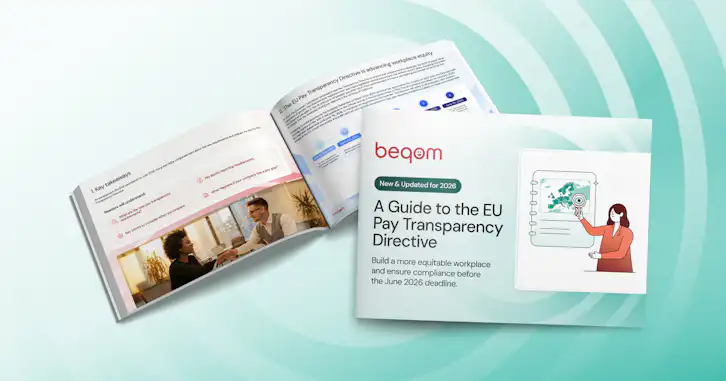
booklet image of the EU Pay Transparency Directive 2026 eGuide

Download our EU Pay Transparency Directive 2026 eGuide

Starting June 2026, organizations across the EU must comply with sweeping new pay transparency and equity regulations. Our new and updated eGuide gives you the clarity, strategies, and tools you need to act now—before it’s too late.

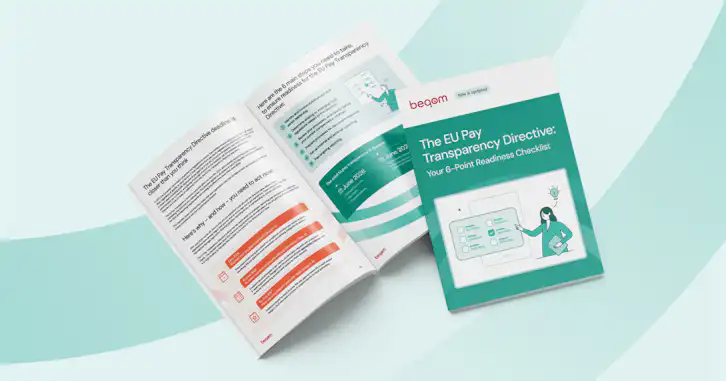
The EUPTD readiness checklist

EU Pay Transparency Directive Compliance Checklist

The June 2026 transposition deadline has now passed. We’ve put together a 43-step Compliance Checklist to help you ensure every aspect of the legislation is covered. Now’s the time to secure your organization against important fines, costly litigation, and reputational damage.

Dive into other Pay Transparency resources

Each guide, article or webinar is designed to help you navigate common pain points and complex compliance challenges with confidence. Learn from beqom’s thought leaders who distill complex topics into accessible, actionable recommendations. We provide proven frameworks and real-world examples, keeping you up to date with the latest legislation and helping you stay compliant while driving employee engagement.

Photo de Jane Anderson et Cristina Flores.
Gestion des Rémunérations Transformation RH

Du tableur à la stratégie : digitaliser la rémunération avec beqom et T. Rowe Price

Lorsque vous dépassez le stade des tableurs, le principal obstacle n'est pas la technologie, c'est la transition. Rejoignez les experts en rémunération de beqom et de T. Rowe Price afin de découvrir concrètement comment passer d'un suivi manuel chaotique à une solution de rémunération unifiée et stratégique. Découvrez les modèles précis d'optimisation, de tests d'acceptation par les utilisateurs et de gestion du changement qui transforment les utilisateurs clés en ambassadeurs de la plateforme.

Photo de Julian Alzueta et Sébastien Baehni
Gestion des Rémunérations

IA intentionnelle et rémunération : utiliser une IA explicable | échange de 30 min

Chaque décision en matière de rémunération a un impact direct sur le quotidien des collaborateurs : privilégier la rapidité ne suffit pas, la responsabilisation est essentielle. Découvrez dans cette vidéo l'intervention du directeur de l'IA de beqom, le Dr Julian Perez Alzueta, et du CTO, le Dr Sébastien Baehni, afin de découvrir comment dépasser l'IA générique au profit d'un système d'intelligence garantissant le contrôle humain sur les décisions clés.

Images de Lara Winzen de beqom et Kerstin Willer de Erste Group.
Pay transparency Équité Salariale

Démarrer ou stagner : transparence salariale en évolution, avec beqom et Erste Group

Bien que l'échéance de juin 2026 pour la directive européenne sur la transparence des rémunérations approche à grands pas, plusieurs États membres ont confirmé des retards dans sa transposition. Visionnez cette session d'experts avec beqom et Erste Group afin de découvrir pourquoi attendre n'est pas une option et comment préparer proactivement la stratégie de conformité de votre organisation dès aujourd'hui.

Portraits de Vismay Gada et Ankur Sharma
Gestion des Rémunérations

Webinaire : L'état de la rémunération et de la culture en 2026

Découvrez comment le paysage de la rémunération est passé de cycles administratifs à un levier essentiel de la culture d'entreprise et de la stratégie de la direction générale. Lors de cette session, Vismay Gada (beqom) et Ankur Sharma (Montefiore) explorent les principales conclusions du 2026 State of Comp and Culture Report.