

Ein Leitfaden für 2026 zur EU-Entgelttransparenzrichtlinie | Laden Sie unseren eGuide herunter.

🇲🇹 Malta

Malta: EU Pay Transparency Directive legislation at a glance

To transpose the EU Pay Transparency Directive fully and on time, Malta established its Equal Pay (Transparency and Reporting) Regulations 2026 via Legal Notice 173 of 2026. While mostly reflecting the EUPTD baseline requirements, Malta is distinguished by more stringent internal documentation thresholds, a very short required response time for right to information requests, and clear fines for noncompliance.

Map of Malta.

Transposition

At a glance

A Bell Icon

Effective date

June 5th, 2026 for most elements; first pay gap reports are due June 7th, 2027 (first annual reports for employers with 250+ employees and triennial reports for those 150–249 employees) and June 7th, 2031 (triennial reports for those with 100–149 employees.)

A people group icon

Size of companies impacted

Reporting requirements track the EUPTD requirements (100+ employees); however, companies with 50+ employees must have formalized, written pay structures and progression criteria that are accessible to employees, and those with 25+ employees must have formalized, written pay structures in place.

A paper scroll icon

Pay transparency provisions for job applicants

Employers must provide applicants with information about pay or the pay range; this information must be provided before the recruitment process concludes in order to make sure negotiations are transparent.

A slider icon

Defining categories of workers and work of equal value

Defined based on the skills, effort, responsibilities, and working conditions necessary for the role.

Pay Equity icon graphic

Right to information

Employees have the right to receive, in writing, information about their pay and the pay, broken down by gender, of other employees who do the same work or work of equal value. The required response time for employers is 8 days.

Transparency in small groups

If providing peer-average data would jeopardize the confidentiality of one employee in a group, then this information must not be provided through direct delivery. Data must be routed through employee representatives, the State Labour Inspectorate, or the Office of the Equal Opportunities Ombudsperson.

Remediation & joint pay assessments

Employers must remediate any pay gaps of 5% or more within 6 months, otherwise they will need to conduct a joint pay assessment. The timeline for remediation must be determined in consultation with the employees’ representative.

Legal Interpretation

How legislation in Malta interprets the EU Directive’s requirements

By and large, Malta’s new Equal Pay (Transparency and Reporting) Regulations track the EU Pay Transparency Directive. However, Malta is distinguished by its low employer size threshold for pay structure documentation and by some strict response times and penalty structures. Specifically:

  • Employers must respond to employees’ right to information requests within only 8 days; this is the shortest required turnaround among all EU member states. Employers who delay beyond 45 days may face enforcement actions.
  • All organizations with 25 or more employees must document their pay criteria in writing. Those with 50 or more must make those criteria, as well as criteria for advancement, readily available to employees.
  • Employers must keep employee pay disclosures and right to information requests and documentation on file for at least 5 years.
  • The law specifies a fine structure: €2,500 to €5,000 for general compliance violations and €5,000 to €7,000 for violations of the equal pay for work of equal value principle.

Get ready to respond quickly to employee requests in Malta

With regulations in effect immediately and tight turnarounds required for right to information requests, organization and system efficiency are crucial for employers in Malta. beqom's industry-leading pay equity and transparency solution, can give you the insights you need to close pay gaps, visualize and analyze pay structures, drill down to investigate compensation at the category and individual levels, and make data-driven decisions. To see how your organization can benefit, request a personalized demo.

If you want to learn more, our EU Pay Transparency Directive eGuide gives a user-friendly breakdown of all the requirements. Our EU Directive Checklist offers a 43-step plan that makes sure that nothing falls through the cracks.

Activity by member state

EU Pay Transparency Directive Transposition Tracker

EU member states are working to transpose the EU Pay Transparency Directive into national law. We’ve created this page to keep track of each member state’s progress.

Visit the EUPTD Tracker
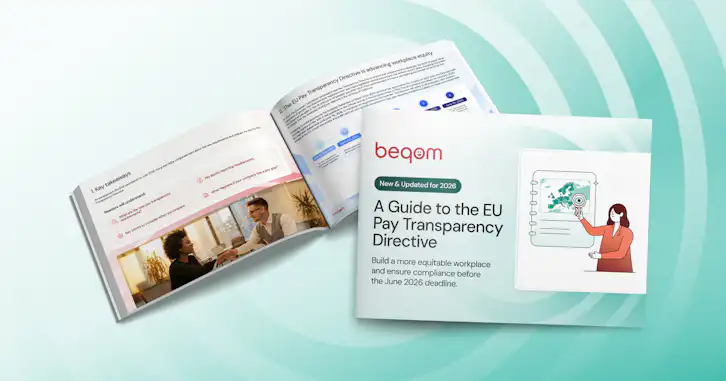
booklet image of the EU Pay Transparency Directive 2026 eGuide

Download our EU Pay Transparency Directive 2026 eGuide

Starting June 2026, organizations across the EU must comply with sweeping new pay transparency and equity regulations. Our new and updated eGuide gives you the clarity, strategies, and tools you need to act now—before it’s too late.

The EUPTD readiness checklist

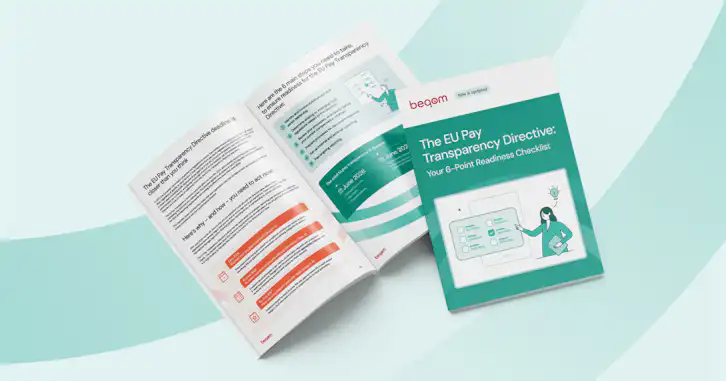
EU Pay Transparency Directive Compliance Checklist

The June 2026 transposition deadline has now passed. We’ve put together a 43-step Compliance Checklist to help you ensure every aspect of the legislation is covered. Now’s the time to secure your organization against important fines, costly litigation, and reputational damage.

Dive into other Pay Transparency resources

Each guide, article or webinar is designed to help you navigate common pain points and complex compliance challenges with confidence. Learn from beqom’s thought leaders who distill complex topics into accessible, actionable recommendations. We provide proven frameworks and real-world examples, keeping you up to date with the latest legislation and helping you stay compliant while driving employee engagement.

Foto von Jane Anderson und Cristina Flores
Vergütungsmanagement HR-Transformation

Von Tabellenkalkulationen zur Strategie: Praxistipps zur Implementierung einer Vergütungslösung, mit beqom & T. Rowe Price

Wenn Sie über Tabellenkalkulationen hinauswachsen, ist die größte Hürde nicht die Technologie – sondern der Übergang. Erfahren Sie von den Vergütungsexperten von beqom und T. Rowe Price aus erster Hand, wie der Wechsel von einer chaotischen manuellen Nachverfolgung zu einer einheitlichen, strategischen Vergütungslösung gelingt. Erhalten Sie konkrete Blueprints für die Optimierung, User Acceptance Testing und Change-Management.

Bild von Julian Alzueta und Sebastien Baehni
KI Vergütungsmanagement

Intentional AI in der Vergütung: Wie Sie erklärbare KI einsetzen können | Ein 30-minütiges Kamingespräch

Jede Vergütungsentscheidung beeinflusst eine Existenzgrundlage. Schnelligkeit allein reicht daher nicht aus – gefragt ist Verantwortlichkeit. Sehen Sie sich dieses Video mit beqoms Head of AI, Dr. Julian Perez Alzueta, und CTO, Dr. Sébastien Baehni, an und erfahren Sie, wie Sie über eine generische KI hinausgehen und ein intelligentes System etablieren, bei dem der Mensch die Kontrolle über die wesentlichen Entscheidungen behält.

Bilder von Lara Winzen von beqom und Kerstin Willer von der Erste Group.
Pay transparency Pay Equity

Neustart oder Stillstand? Das Rätsel der Entgelttransparenz lösen in Zeiten sich wandelnder Vorschriften – mit beqom und Erste Group

Obwohl die Deadline der EU-Richtlinie zur Entgelttransparenz im Juni 2026 rasch näher rückt, haben mehrere Mitgliedstaaten Verzögerungen bei deren Umsetzung bestätigt. Sehen Sie sich diese Experten-Session mit beqom und der Erste Group an, um zu erfahren, warum Abwarten keine Option ist und wie Sie die Compliance-Strategie Ihres Unternehmens schon heute proaktiv vorbereiten.