Navigating Adjusted vs. Unadjusted Pay Gaps for EU Reporting
 Written by Gudrun ThorgeirsdottirLast updated on May 13, 2026
Learn more about the following beqom products

Perhaps the most frequently cited global pay equity statistic is this: a woman on average earns about 80 cents for every dollar a man earns. This popular pay gap statistic is accurate—but it doesn’t tell the whole story. And it’s not the only way to measure a pay gap.
There are two types of pay gaps: the unadjusted or uncontrolled pay gap, and the adjusted or controlled pay gap. These measurements are used at different times, and they tell you different things about your workplace.
In this article, we explain the difference between the adjusted and unadjusted pay gaps, talk about when to use each one, and explain how to calculate the gender pay gap.
The uncontrolled pay gap and the controlled pay gap
The main difference between the unadjusted and adjusted pay gap measures is the information they consider. The unadjusted (uncontrolled) pay gap only considers average pay, and it looks at the difference between the average pay for each gender. This is the simpler of the two measures. The mathematical calculation is straightforward and can be done quite quickly.
That eighty-cents-on-the-dollar statistic? That’s an unadjusted (uncontrolled) pay gap measurement.
The adjusted (controlled) pay gap considers t other factors that can influence pay, like experience, education, and workplace location. For example, an organization’s female workforce might have less experience on average, and thus be paid less.
This may lead to a relatively high unadjusted pay gap but a low adjusted pay gap. In other words, the difference in pay here isn’t due to bias or discrimination, but other factors. To improve pay equity overall, the organization may ask what it can do to reach parity across genders in higher-paying roles, which would narrow the unadjusted pay gap.
Calculating the adjusted pay gap is much more complex. It requires a mathematical process called regression analysis.
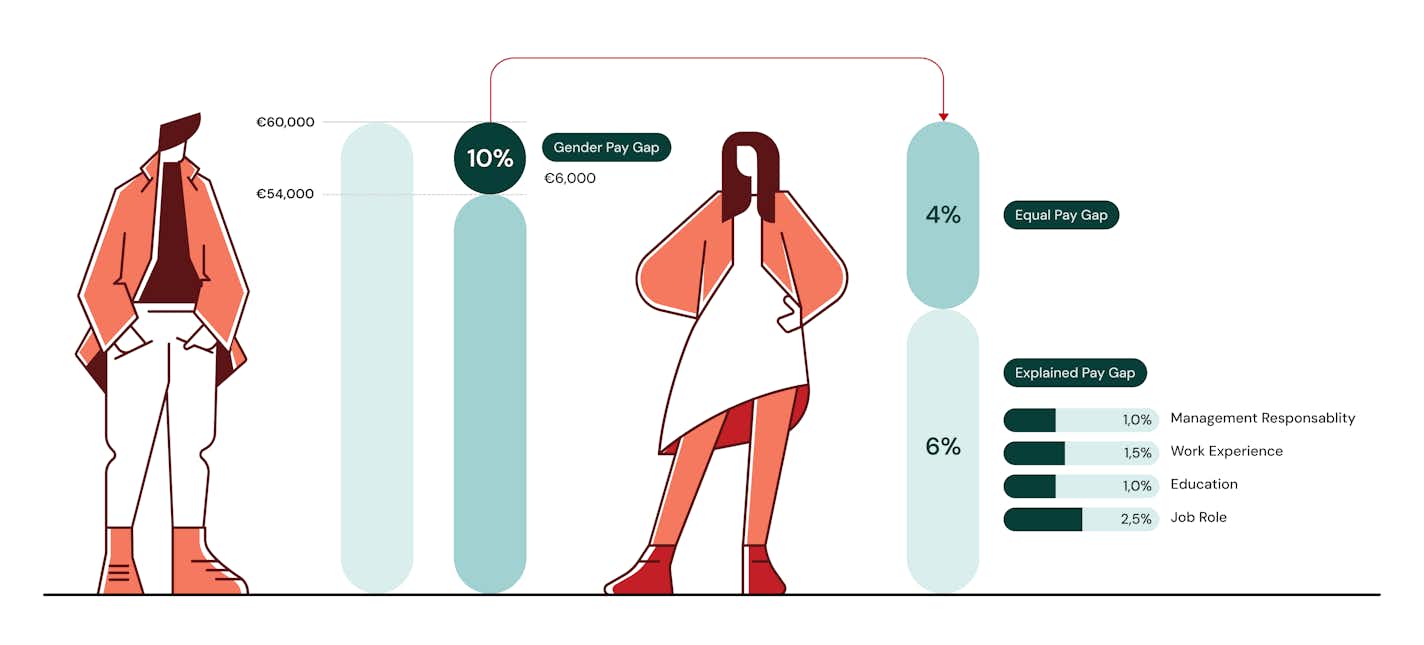
Regression analysis: Calculating your adjusted pay gap
Regression analysis involves a series of regression equations. Specifically, PayAnalytics by beqom uses what’s known as log-linear regression—the industry standard for pay equity research, regulation, and software development.
A log-linear regression equation looks like this:
log(Salary) = Intercept + β1 Gender + β2 Education + β3 * Experience + …. + error.
Here, β is the regression coefficient, and it explains the influence of each variable. For example, a regression coefficient of 0.03 for education would mean that each additional educational level contributes to a 3% increase in pay.
A regression analysis also gives us a p-value, which tells us how likely it is that this correspondence found by the regression equation—more education means more pay—is just due to random chance. A low p-value (below 0.05 or 0.1) means the result is “statistically significant,” which means that the influence we are seeing is real.
In beqom's Pay Equity & Transparency tool, you get these calculations in just a few clicks. To learn more about how our pay equity solution can support your organization or to see a demo, drop us a line.
At the same time, the analysis considers all of these factors in relationship to gender – or whatever demographic category you want to look at. At the end of your regression analysis, you will see the factors that influence pay at your organization. After taking all those factors into consideration, it will become clear if there is a demographic pay gap.
The beauty of log-linear regression is that you can pick the factors that are important to your organization. For instance, if your industry makes heavy use of professional certifications and employees with more certifications should be compensated more, you can include certification level as a factor in regression analysis.
Whose work are we comparing?
Regression analysis requires job classification, or breaking your workforce down into job roles that are analytically meaningful and where similar qualities are valued. For instance, engineering jobs and sales jobs might require different educational levels. For employers covered under the EU Pay Transparency Directive, specific job classification practices are required—see our article on defining categories of workers.
Another consideration is equal pay for work of equal value. Traditionally, pay equity was thought about in terms of equal pay for equal work.
Now, it’s more common to consider equal pay for work of equal value. This is because one gender might be dominant in certain job roles, even though the roles themselves might make equal contributions to the organization, and might be similar in terms of employees’ skills, education, and responsibility.
Reporting for the EU Pay Transparency Directive
The Directive requires employers to report data related to the gender pay gap and general demographics. Most of this pay gap data will be unadjusted. However, an adjusted measurement may be critical in determining your organization’s compliance.
While the final legislation may vary a little by country—see our EU Directive transposition activity page for details and nuances—all countries will require the following: an unadjusted measurement of the overall pay gap, plus eight more specific calculations.
These calculations include breakdowns by categories of workers and by quartile pay bands, median pay gap measurements, data about variable compensation, and data on raises following leave. (Article 9 of the EU Directive)
If the unadjusted measurement of the overall pay gap is 5% or greater, employers will need to provide an adjusted pay gap measurement. This measurement should account for objective, gender-neutral factors like job roles and experience.
If the adjusted pay gap is still 5% or greater, then employers will need to take corrective action in a short time frame (six months), or conduct a joint pay assessment and generate a gender action plan to close the gap. (Article 10)
Download our free eGuide for more information about the EU Directive: pay equity reporting, pay transparency measures, and how to prepare.
To find out more on the laws in place where your organization operates, please see our local requirements page.
Closing a pay gap
Regardless of your market and its reporting requirements, both measurements are important if you want to close or narrow a pay gap.
In this case, we advise organizations to start with the unadjusted pay gap—the big picture of any gender discrepancy in pay. Even a small pay gap can mean that there is bias within your organization’s pay structure. After you’ve planned your response to the unadjusted pay gap, you can then close the adjusted gap.
How PayAnalytics by beqom can help
Decades ago, a regression analysis involved hiring a consultant or specialist to solve equations one math problem at a time. PayAnalytics by beqom made a technological breakthrough automating the pay equity analysis process. We deliver log-linear regression calculations with just one click—and present them in a way that is easy to understand.
You’ll see your unadjusted pay gap, your adjusted pay gap, and the factors that influence pay. You can then break down the data in whatever way you need, including worker categories and pay bands.
Our software solution also provides:
- Streamlined reporting for many countries—generate compliance-ready reports at the click of a button.
- An industry-leading workplace equity tool—see where your pay gaps are coming from and how to close them.
- A compensation assistant that makes sure each compensation decision preserves pay equity—protect the progress you’ve made.
Please contact us to learn more about how our Pay Equity & Transparency tool can help your organization.