Why the Best Compensation AI Always Keeps Humans in the Loop
 Written by Clare Bonham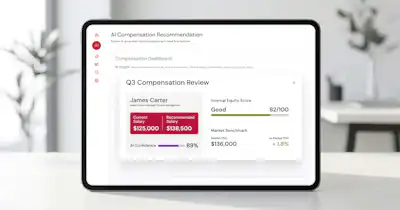
Learn more about the following beqom products


AI has the potential to make compensation decisions faster, fairer, and more consistent — but only when it works alongside human judgment rather than replacing it. For HR leaders, CHROs, and comp professionals, a collaborative approach to AI means your managers are better prepared, your pay decisions are more defensible, and your people have greater confidence that the humans who know them are still the ones making the call.
This article is the second in our series on Intentional AI, based on beqom's whitepaper, Modeling with Intention, and follows on from the first article which focused on Explainable AI. This article explores the second pillar: the principle that AI supports people, and people make the decisions.
What does "human in the loop" mean in compensation AI?
Human in the loop means that AI handles the heavy analytical work — synthesizing data, surfacing patterns, generating recommendations — while a person makes the final call on any decision that affects someone's pay or career. The AI is an intelligent co-pilot, not an autonomous decision-maker.
In practice, this looks like a manager receiving a data-backed salary recommendation for a merit review, with full context on where the employee sits within their band, how they compare to peers, and what the budget constraints allow. The manager reviews the recommendation, adjusts it if needed, and approves the outcome. The AI did the preparation. The manager made the decision.
This model is central to beqom's whitepaper, Modeling with Intention, which frames Intentional AI as a partnership between governed AI systems and human authority — not a handover of control. Read the full whitepaper to explore the complete framework.
Why can't AI just make compensation decisions automatically?
This is one of the most common questions from leaders exploring AI in HR, and the answer starts with context. Compensation decisions are loaded with information that no AI system can fully infer from data alone. A high-potential employee on a stretch assignment. A team member who informally took on a manager's responsibilities during a leave. A candidate whose market value is shifting faster than survey data reflects. These factors are real and they matter, but they do not live in a database. They live in the knowledge of the managers and HR professionals who work closely with people every day.
Regulation adds another layer. The EU AI Act, being phased in through 2026 and 2027, specifically requires human review in high-stakes AI applications — and pay decisions clearly fall into that category. Organizations that hand final authority to an algorithm are taking on regulatory exposure that will only grow as these laws tighten.
Then there is the accountability question, which may be the most fundamental of all. When a compensation decision goes wrong or is challenged, "the algorithm decided" does not satisfy an employee, a regulator, or a board. Clear human ownership of the final decision is what makes accountability real and defensible.
What should AI do, and what should humans do?
The right division of responsibility is one of the most valuable frameworks compensation leaders can establish before implementing AI. As WTW Senior Managing Director Lesli Jennings puts it in beqom's Intentional AI whitepaper, the real opportunity is "to move away from one-time comp events to a continuous system in which market data, job changes, equity signals, and talent needs continuously feed into the next decision." AI is what makes that continuous system possible — but humans are what make it trustworthy.
A well-designed collaborative system divides the work like this:
- AI handles data aggregation, pattern recognition, scenario modeling, pay gap analysis, and first-pass recommendations.
- Managers contribute contextual knowledge — awareness of individual circumstances, team dynamics, and qualitative performance signals that data cannot capture.
- HR provides governance, policy interpretation, and the final check on outcomes before they are communicated.
- Compliance and legal functions benefit from the audit trail the system produces, without having to build it manually.
This division does not slow things down. It removes the manual calculation burden from managers and HR while ensuring the people closest to each decision remain in charge of it.
How does collaborative AI change the role of managers?
One concern HR leaders often raise is that AI will remove the human element from pay conversations — making managers feel like order-processors rather than leaders. A well-designed collaborative AI model does the opposite.
By handling data preparation and first-pass recommendations, AI frees managers from the spreadsheet work that currently dominates merit cycles. Instead of spending hours calculating where each employee sits against band midpoints, managers can spend that time on the conversations that matter: explaining decisions, connecting pay to performance, and addressing individual questions with empathy and context.
As WTW's Tom Hellier notes in beqom's Intentional AI whitepaper, this is precisely where human value lies — "delivering with empathy: owning pay conversations to ensure the message that lands includes an explanation of the 'why' beyond a calculation." AI can produce the number. Only a manager can make it feel fair.
What happens when AI and human judgment disagree?
In a well-designed collaborative system, this is a feature, not a problem. When a manager adjusts or overrides an AI recommendation, that action is logged, documented, and available for review. Over time, patterns in those overrides become valuable signals: they may indicate that a policy is outdated, that market data needs refreshing, or that a particular team or function has unique dynamics the model should account for.
This feedback loop is part of what makes collaborative AI better over time. The AI learns from how humans respond to its recommendations. Humans learn from seeing where their intuition and the data align — and where they diverge.
This is a significant improvement over purely manual processes, where the reasoning behind individual decisions is rarely documented at all, and patterns of inconsistency are invisible until they surface as pay equity problems.
Does a human-in-the-loop approach slow down compensation cycles?
This is a practical concern for compensation teams under pressure to move quickly. The answer depends on how the system is designed. When AI does the analytical preparation — pulling together all relevant data into a clear, reviewed recommendation — the human review step becomes faster and more focused, not slower.
Managers are reviewing a recommendation with full context, rather than assembling that context themselves. HR is approving outcomes against clear policy criteria, rather than checking calculations manually. The human step is leaner because the AI step is more complete.
beqom's Compensation Trends Report found that 56% of respondents said AI features are "very important" for automating common compensation procedures. The collaborative model is what makes that automation safe: it captures the speed benefits of AI while preserving the human judgment that makes decisions defensible.
How does collaborative AI support pay equity goals?
Pay equity is one area where the combination of AI analysis and human oversight is especially powerful. AI can surface patterns that humans might miss — gaps by gender, ethnicity, tenure, or geography that are invisible when data is reviewed in spreadsheets. But identifying a gap and deciding how to address it are two different things.
Human judgment is essential for understanding why a gap exists, whether it reflects a structural issue in job architecture, a historical pattern in how certain roles were graded, or something that requires immediate remediation. AI flags the signal. People interpret it and act on it.
This is why collaborative AI is foundational to sustainable pay equity progress, not just compliance. It brings data-driven rigor to an area where inconsistency has historically been difficult to detect — while keeping the decisions that shape people's careers in human hands.
Building a collaborative AI model in your organization
The first step is clarity about where human judgment is non-negotiable. Any decision that directly affects a person's base pay, bonus, promotion, or career trajectory should have a documented human approval step. AI can inform and prepare that step, but it should not bypass it.
The second step is making that collaboration seamless. If the handoff between AI recommendation and human review is cumbersome — if managers have to navigate multiple systems, re-enter data, or spend time deciphering what the AI did — the benefits are lost. The best collaborative AI is invisible: it does the work in the background and surfaces a clean, actionable recommendation that a manager can review and act on in minutes.
beqom is built for exactly this model. Its platform combines governed compensation data, ML-powered modeling, and agentic AI guidance into a single, connected experience — so managers get the preparation they need, HR retains oversight, and every decision comes with a complete audit trail.
If you are ready to explore how collaborative AI can transform your compensation process, book a demo with beqom and see the model in action.