
Pay Equity
Scarica la checklist beqom di conformità alla Direttiva UE sulla trasparenza salariale
Il termine per la Direttiva UE sulla trasparenza retributiva è scaduto. Scopri a che punto si trova la tua azienda e cosa correggere subito.
Quanto è conforme la tua azienda alla Direttiva UE sulla trasparenza retributiva? Completa la nostra checklist per scoprirlo.
To implement the EU Pay Transparency Directive, Lithuania passed Law No. XV-969 to expand the nation’s Labour Code. The law sets up a series of sequential deadlines that cover all the elements of the Directive. Lithuania’s interpretation of the EUPTD is noteworthy for requiring employers of all sizes to establish documented pay structures and to report payroll data monthly.

Transposition

Sequential deadlines, with June 7th, 2026 for certain transparency laws; pay system compliance required by December 31st, 2026; the Right to Information comes into effect on January 1st, 2027; and the required monthly data submissions for all employers begins February 28th, 2027.

Employers of all sizes must have a written remuneration system and must continue to report data monthly to the State Social Insurance Fund Board (SoDRA); employers with temporary employees must report relevant data annually (those with 250+ employees) or triennially (100–249 employees).

Job postings must include the pay or pay range for the position (this has been required since 2019). Employers must provide applicants with information about pay or the pay range. The precise timing is up to the employer, but publishing this information in the job posting would meet the requirement. Applicants must also be informed about applicable collective agreements prior to contract signing.
In Lithuania, employers of all sizes submit monthly payroll/employee data to SoDRA. This data includes designated job classification groups. SoDRA will then calculate the pay gaps; this is done annually for employers with 250 or more employees and every three years for those with 100–249 employees. All employers must establish a pay structure where positions are grouped by objective, gender-neutral criteria, including hard and soft skills, qualifications, physical/mental/emotional effort, responsibility, and working conditions. Employers with 50 or more employees must also document criteria for pay progression.

Employers must annually inform employees of their rights. Response time for employee pay info requests is 1 month.

If providing data for a group of employees would directly or indirectly reveal one identifiable individual’s salary, then the employer cannot deliver this information directly to the employee. In this situation, data must be routed through employee representatives, the State Labour Inspectorate, or the Office of the Equal Opportunities Ombudsperson.

In line with the EUPTD baseline, pay gaps 5% or more must be remediated within 6 months after reporting date. If the pay gap is not remediated, a joint pay assessment must be conducted.
Legal Interpretation
Many of the requirements, timelines, and employer size thresholds in Lithuania’s new laws track the EU Directive’s baseline guidance. However, there are some key exceptions that have the effect of making the law more comprehensive and stringent.
Insight into the existing pay structure would allow your organization to anticipate your findings and begin addressing any pay gaps before SoDRA makes information publicly visible in 2028. beqom Pay Equity and Transparency platform offers powerful tools to make data-driven decisions, close pay gaps in the most efficient way possible, and keep the gaps closed during any future hiring and promotion decisions.
Schedule a personalized demo to see how your organization can benefit.
Activity by member state
EU member states are working to transpose the EU Pay Transparency Directive into national law. We’ve created this page to keep track of each member state’s progress.

Starting June 2026, organizations across the EU must comply with sweeping new pay transparency and equity regulations. Our new and updated eGuide gives you the clarity, strategies, and tools you need to act now—before it’s too late.
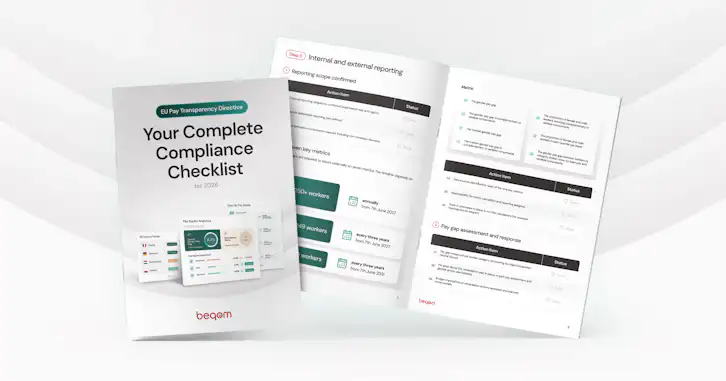
The June 2026 transposition deadline has now passed. We’ve put together a 6-Point Readiness Checklist to help you ensure every aspect of the legislation is covered. Now’s the time to secure your organization against important fines, costly litigation, and reputational damage.
Each guide, article or webinar is designed to help you navigate common pain points and complex compliance challenges with confidence. Learn from beqom’s thought leaders who distill complex topics into accessible, actionable recommendations. We provide proven frameworks and real-world examples, keeping you up to date with the latest legislation and helping you stay compliant while driving employee engagement.
Il termine per la Direttiva UE sulla trasparenza retributiva è scaduto. Scopri a che punto si trova la tua azienda e cosa correggere subito.

Anche se la scadenza di giugno 2026 per la trasparenza retributiva UE si sta avvicinando rapidamente, diversi Paesi membri hanno confermato ritardi nel suo recepimento. Segui questa sessione con gli esperti di beqom ed Erste Group per scoprire perché attendere non è un'opzione e come preparare proattivamente la strategia di compliance della tua organizzazione oggi stesso.

L’attuale obbligo di comunicazione del pay gap in Francia è stato introdotto nel 2018 e implementato gradualmente. Il report richiesto (l’*Index de l’égalité professionnelle femmes-hommes*) è noto in inglese come “gender equality index”.

Scarica l'eGuide. Crea un ambiente di lavoro equo e prepara la tua azienda alla normativa UE sulla trasparenza e sull'equità retributiva.

Leggi il Report europeo 2026 sulle Retribuzioni e sulla Cultura Aziendale di beqom per scoprire come le principali organizzazioni europee stanno sfruttando le nuove direttive per modernizzare la compensation, integrare l'AI e gestire la complessità globale.

Guarda il webinar esclusivo di beqom e Allshares per approfondire la preparazione dei dati dell'ultimo miglio e i passaggi strategici per garantire la conformità alla Direttiva UE entro il 2026.