
Estonia
Estonia has partially implemented the EU Pay Transparency Directive under a unique split strategy.
95% of HR and comp leaders believe comp dollars could be better spent. Get the Pay Intelligence Report.
To implement the EU Pay Transparency Directive, Lithuania passed Law No. XV-969 to expand the nation’s Labour Code. The law sets up a series of sequential deadlines that cover all the elements of the Directive. Lithuania’s interpretation of the EUPTD is noteworthy for requiring employers of all sizes to establish documented pay structures and to report payroll data monthly.

Transposition

Sequential deadlines, with June 7th, 2026 for certain transparency laws; pay system compliance required by December 31st, 2026; the Right to Information comes into effect on January 1st, 2027; and the required monthly data submissions for all employers begins February 28th, 2027.

Employers of all sizes must have a written remuneration system and must continue to report data monthly to the State Social Insurance Fund Board (SoDRA); employers with temporary employees must report relevant data annually (those with 250+ employees) or triennially (100–249 employees).

Job postings must include the pay or pay range for the position (this has been required since 2019). Employers must provide applicants with information about pay or the pay range. The precise timing is up to the employer, but publishing this information in the job posting would meet the requirement. Applicants must also be informed about applicable collective agreements prior to contract signing.

In Lithuania, employers of all sizes submit monthly payroll/employee data to SoDRA. This data includes designated job classification groups. SoDRA will then calculate the pay gaps; this is done annually for employers with 250 or more employees and every three years for those with 100–249 employees. All employers must establish a pay structure where positions are grouped by objective, gender-neutral criteria, including hard and soft skills, qualifications, physical/mental/emotional effort, responsibility, and working conditions. Employers with 50 or more employees must also document criteria for pay progression.

Employers must annually inform employees of their rights. Response time for employee pay info requests is 1 month.

If providing data for a group of employees would directly or indirectly reveal one identifiable individual’s salary, then the employer cannot deliver this information directly to the employee. In this situation, data must be routed through employee representatives, the State Labour Inspectorate, or the Office of the Equal Opportunities Ombudsperson.

In line with the EUPTD baseline, pay gaps 5% or more must be remediated within 6 months after reporting date. If the pay gap is not remediated, a joint pay assessment must be conducted.
Legal Interpretation
Many of the requirements, timelines, and employer size thresholds in Lithuania’s new laws track the EU Directive’s baseline guidance. However, there are some key exceptions that have the effect of making the law more comprehensive and stringent.
Insight into the existing pay structure would allow your organization to anticipate your findings and begin addressing any pay gaps before SoDRA makes information publicly visible in 2028. beqom Pay Equity and Transparency platform offers powerful tools to make data-driven decisions, close pay gaps in the most efficient way possible, and keep the gaps closed during any future hiring and promotion decisions.
Schedule a personalized demo to see how your organization can benefit.
Activity by member state
EU member states are working to transpose the EU Pay Transparency Directive into national law. We’ve created this page to keep track of each member state’s progress.
National implementation
Each EU member state is putting the EU Pay Transparency Directive into its own national law, and the details vary from country to country. Pick a country to see where its legislation stands, what employers will need to do and when the new rules take effect.
Estonia has partially implemented the EU Pay Transparency Directive under a unique split strategy.

Although France did not meet the June 2026 transposition deadline, a draft bill was presented to the Council of Ministers on September 10th, 2026 and is moving through Parliament.

Greece's transposition took effect July 6, 2026, with several key requirements deferred until November 1, 2026 to ease the transition. The framework follows the EUPTD baseline and includes added safeguards against abusive right-to-information requests.

Italy transposed the EUPTD through Legislative Decree No. 96/2026, effective June 7, 2026.

Malta transposed the EUPTD via the Equal Pay (Transparency and Reporting) Regulations 2026 (Legal Notice 173 of 2026). It largely mirrors the EU baseline, but adds stricter documentation thresholds, a short deadline for right-to-information requests, and clearly defined penalties for noncompliance.

Dutch transposition is still in draft. A first version circulated in March 2025, but the coalition government's collapse delayed progress; the current draft, dated January 20, 2026, amends the Equal Treatment of Men and Women Act of 1980.

Slovakia has fully transposed the EUPTD through its Equal Pay Act (Act No. 76/2026 Coll.). The law follows the EU baseline closely, though some deadlines are tight — offset by provisions that ease compliance for smaller businesses.
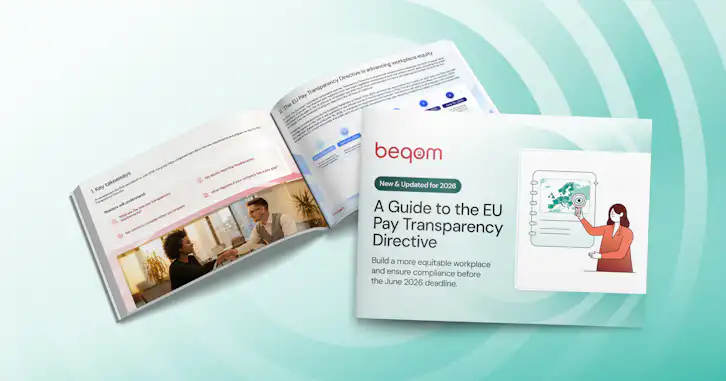
Starting June 2026, organizations across the EU must comply with sweeping new pay transparency and equity regulations. Our new and updated eGuide gives you the clarity, strategies, and tools you need to act now—before it’s too late.

The June 2026 transposition deadline has now passed. We’ve put together a 6-Point Readiness Checklist to help you ensure every aspect of the legislation is covered. Now’s the time to secure your organization against important fines, costly litigation, and reputational damage.
Each guide, article or webinar is designed to help you navigate common pain points and complex compliance challenges with confidence. Learn from beqom’s thought leaders who distill complex topics into accessible, actionable recommendations. We provide proven frameworks and real-world examples, keeping you up to date with the latest legislation and helping you stay compliant while driving employee engagement.

Download the eGuide. Start building an equitable workplace and prepare your company for EU legislation on pay transparency and equity.

Gudrun Thorgeirsdottir and Rachel Gibbs get together for a practical session on building a compliant, audit-ready pay transparency strategy, even without a dedicated team or full job classification.

Europe's pay transparency landscape is still shifting post-deadline. Watch our recent webinar with beqom experts Lara Winzen and Hayley Bakker, and Max Oranski from TUI, for a candid look at what's changed, where member states stand, and what it means for employers on the ground.

The EU Pay Transparency Directive deadline has passed. Find out where your organization stands, and what to fix now.

The EU Pay Transparency Directive deadline has passed. Watch beqom and Mercer unpack what's happening across Europe, and what employers should do next.

Watch this expert session with beqom and Erste Group to discover why waiting for country transposition updates isn't an option, and how to proactively prepare your organization's compliance strategy today.