
Pay Equity
Download beqom’s EU Pay Transparency Directive Compliance Checklist
The EU Pay Transparency Directive deadline has passed. Find out where your organization stands, and what to fix now.
Register now for our upcoming pay transparency webinar with Rachel Gibbs
As of July 6th, 2026, when the new laws took effect, Greece has a full legal framework that transposes all provisions of the EU Pay Transparency Directive. To facilitate adoption, some of the major requirements have been deferred until November 1st, 2026. Greece’s new laws align with the EUPTD baseline, though it includes unique provisions to protect employers from any abusive exercise of employee right to information requests.

Transposition

Definitions of concepts and terms, like definition of pay and pay level and designation of the Greek Ombudsman as the primary monitoring body, took effect July 6th, 2026; requirements for pay transparency, accessibility of pay criteria, and employee’s right to information take effect November 1st, 2026; first pay gap reports are due June 7th, 2027 (first annual reports for employers with 250+ employees and triennial reports for those 150–249 employees) and June 7th, 2031 (triennial reports for those with 100–149 employees).

Reporting requirements track the EUPTD requirements (100+ employees.)

Employers must provide applicants with information about pay or the pay range before the interview stage. Job titles and language used in job postings must be gender-neutral.

Categories of workers are defined as those who perform equal or equivalent work. Equal or equivalent work is determined based on the skills (including relevant behavioral skills), effort, responsibilities, and working conditions necessary for each job role.
Upon request, employers must provide employees with written information about their pay level and the average pay for other employees doing the same work or work of equal value. Employers have 2 months to respond to requests. They also have 2 months to respond to clarification requests, which may be made by the employee, a representative, the Labour Inspectorate, or the Ombudsman. However, if the employer judges an employee request to be abusive or disproportionate — particularly if the request is repetitive — they have the right to refuse it. If the employer does refuse, the employee can then take their request to the Ombudsman, who will decide whether the request is valid.

Employers cannot share category pay averages with an employee if it could potentially reveal a colleague’s salary. In such cases, data must be routed through a trade union, employee representative, the Labour Inspectorate, or the Ombudsman.

Employers must remediate any unjustified pay gap of 5% or more within any category within 6 months. Otherwise, they will need to conduct a joint pay assessment, working with either the trade union or, if there is no trade union, by the three longest-tenured employees.
Legal Interpretation
To ease adoption by employers, Greece opted to delay enforcement of some key elements of the EUPTD until November 1st, 2026. The new laws feature several other adaptations:
As the EUPTD reporting and pay equity requirements come into force, it’s crucial to be able to predict and address pay gaps before they trigger a joint pay assessment. beqom's Pay Equity and Transparency tool automatically highlights any job category where your organization might approach or exceed a 5% adjusted pay gap. And, once the gap is closed, our industry-leading software solution helps make sure it never re-opens.
If you want to learn more, our EU Pay Transparency Directive eGuide gives a user-friendly breakdown of all the requirements. Our EU Directive Checklist offers a 43-step plan that makes sure that nothing falls through the cracks.
Activity by member state
EU member states are working to transpose the EU Pay Transparency Directive into national law. We’ve created this page to keep track of each member state’s progress.
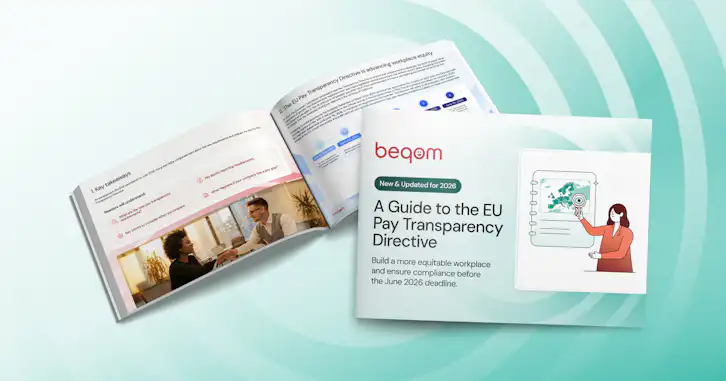
Starting June 2026, organizations across the EU must comply with sweeping new pay transparency and equity regulations. Our new and updated eGuide gives you the clarity, strategies, and tools you need to act now—before it’s too late.
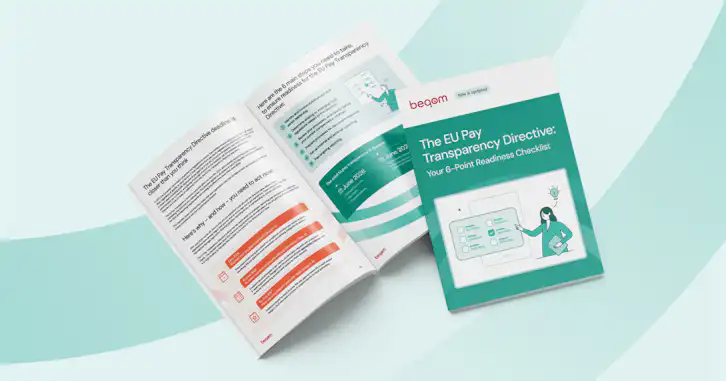
The June 2026 transposition deadline has now passed. We’ve put together a 43-step Compliance Checklist to help you ensure every aspect of the legislation is covered. Now’s the time to secure your organization against important fines, costly litigation, and reputational damage.
Each guide, article or webinar is designed to help you navigate common pain points and complex compliance challenges with confidence. Learn from beqom’s thought leaders who distill complex topics into accessible, actionable recommendations. We provide proven frameworks and real-world examples, keeping you up to date with the latest legislation and helping you stay compliant while driving employee engagement.
The EU Pay Transparency Directive deadline has passed. Find out where your organization stands, and what to fix now.

The EU Pay Transparency Directive deadline has passed. Watch beqom and Mercer unpack what's happening across Europe, and what employers should do next.

Watch this expert session with beqom and Erste Group to discover why waiting for country transposition updates isn't an option, and how to proactively prepare your organization's compliance strategy today.

France’s current pay gap reporting requirement was introduced in 2018 and rolled out gradually. The required report (Index de l’égalité professionnelle femmes-hommes) is known as the “gender equality index” in English.

Download the eGuide. Start building an equitable workplace and prepare your company for EU legislation on pay transparency and equity.

Read beqom's 2026 European Comp & Culture Report to learn how Europe’s leading organizations are leveraging new directives to modernize compensation, integrate AI, and manage global complexity.