
Pay Equity
Download beqom’s EU Pay Transparency Directive Compliance Checklist
The EU Pay Transparency Directive deadline has passed. Find out where your organization stands, and what to fix now.
Register now for our upcoming pay transparency webinar with Rachel Gibbs
Slovakia has fully transposed the EU Pay Transparency Directive through its Equal Pay Act (Act No. 76/2026 Coll. on Equal Pay for Men and Women for Equal Work or Work of Equal Value). While the new requirements mostly follow the norm for member states, some of its deadlines are quite tight, though it has also tailored some provisions to ease the burden for smaller businesses.

Transposition

June 7th, 2026 for most elements; pay structures must be established and documented by July 31st, 2026; first pay gap reports are due June 7th, 2027 (first annual reports for employers with 250+ employees and triennial reports for those 150–249 employees) and June 7th, 2031 (triennial reports for those with 100–149 employees). All subsequent reports are due on April 15th of the respective year.

Reporting requirements track the EUPTD requirements (100+ employees.)

Employers must provide applicants with information about pay or the pay range; this information must be provided prior to the interview or prior to the contract.

Defined based on gender-neutral job evaluation criteria including working conditions, physical demands, complexity, and responsibility.
Employees have the right to receive, in writing, information about their pay level and the criteria used to determine it, and they should be informed of this right once per year. The required employer response time is 2 months for the initial request and 30 days for subsequent follow-up requests. Employee representatives and the Slovak National Centre for Human Rights may also make such requests.

Employers are prohibited from making a broad internal disclosure if the peer-average pay data might allow an employee to deduce a colleague’s pay. In such cases, data must be routed through employee representatives or the Labour Inspectorate.

If the report shows an unjustified gap of 5% or more in any worker category, the employer must remediate the gap within 6 months, otherwise they will need to work with employee representatives to conduct a joint pay assessment.
Legal Interpretation
Many of the requirements implemented in Slovakia are aligned with the EUPTD baseline. However, legislators made a number of adjustments, as follows:
To support employers in complying with the new requirements, Slovakia’s government has published a methodology document.
Slovakia has extended equal pay protections beyond male-female categories, and employers are already required to have compliant pay structures in place. Built on industry-leading research, beqom's Pay Equity and Transparency tool is a user-friendly platform that delivers detailed insight into your organization’s pay structure so you can make sure it is equitable for all employees, Directive-compliant, and sustainable.
If you want to learn more, our EU Pay Transparency Directive eGuide gives a user-friendly breakdown of all the requirements. Our EU Directive Compliance Checklist offers a 43-step plan that makes sure that nothing falls through the cracks.
Activity by member state
EU member states are working to transpose the EU Pay Transparency Directive into national law. We’ve created this page to keep track of each member state’s progress.
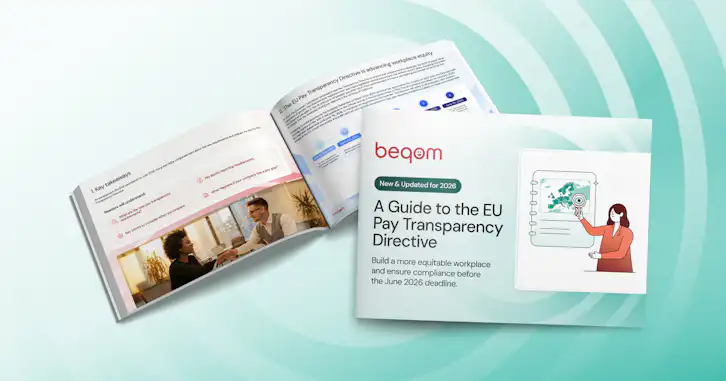
Starting June 2026, organizations across the EU must comply with sweeping new pay transparency and equity regulations. Our new and updated eGuide gives you the clarity, strategies, and tools you need to act now—before it’s too late.
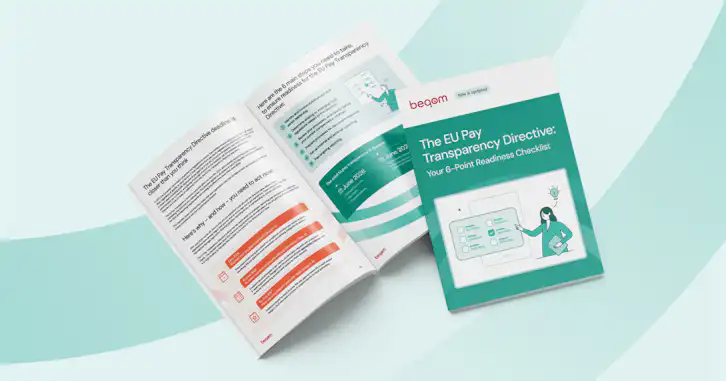
The June 2026 transposition deadline has now passed. We’ve put together a 43-step Compliance Checklist to help you ensure every aspect of the legislation is covered. Now’s the time to secure your organization against important fines, costly litigation, and reputational damage.
Each guide, article or webinar is designed to help you navigate common pain points and complex compliance challenges with confidence. Learn from beqom’s thought leaders who distill complex topics into accessible, actionable recommendations. We provide proven frameworks and real-world examples, keeping you up to date with the latest legislation and helping you stay compliant while driving employee engagement.
The EU Pay Transparency Directive deadline has passed. Find out where your organization stands, and what to fix now.

The EU Pay Transparency Directive deadline has passed. Watch beqom and Mercer unpack what's happening across Europe, and what employers should do next.

Watch this expert session with beqom and Erste Group to discover why waiting for country transposition updates isn't an option, and how to proactively prepare your organization's compliance strategy today.

France’s current pay gap reporting requirement was introduced in 2018 and rolled out gradually. The required report (Index de l’égalité professionnelle femmes-hommes) is known as the “gender equality index” in English.

Download the eGuide. Start building an equitable workplace and prepare your company for EU legislation on pay transparency and equity.

Read beqom's 2026 European Comp & Culture Report to learn how Europe’s leading organizations are leveraging new directives to modernize compensation, integrate AI, and manage global complexity.